AIMD
Robert J. Moore
Introduction
Artificial Intelligence (AI) is rapidly over-taking organic cognitive power.1 The online, and physical landscape has been everchanging since the popularization of Large Language Models (LLMs). AI can be seen as a logorithm of yes–no, or true–false, statements that sequentially result in some output. This is a gross simplification of the true math involved in constructing A.I. to its known performance.2 LLMs are, as in the name: large. The language model side of the LLM operates on the language(s) we use: common parlance, or technical language. Of course, medicine (MD, or PhD) is a broad scope of practice that encompases the known, and unknown, human body affects.
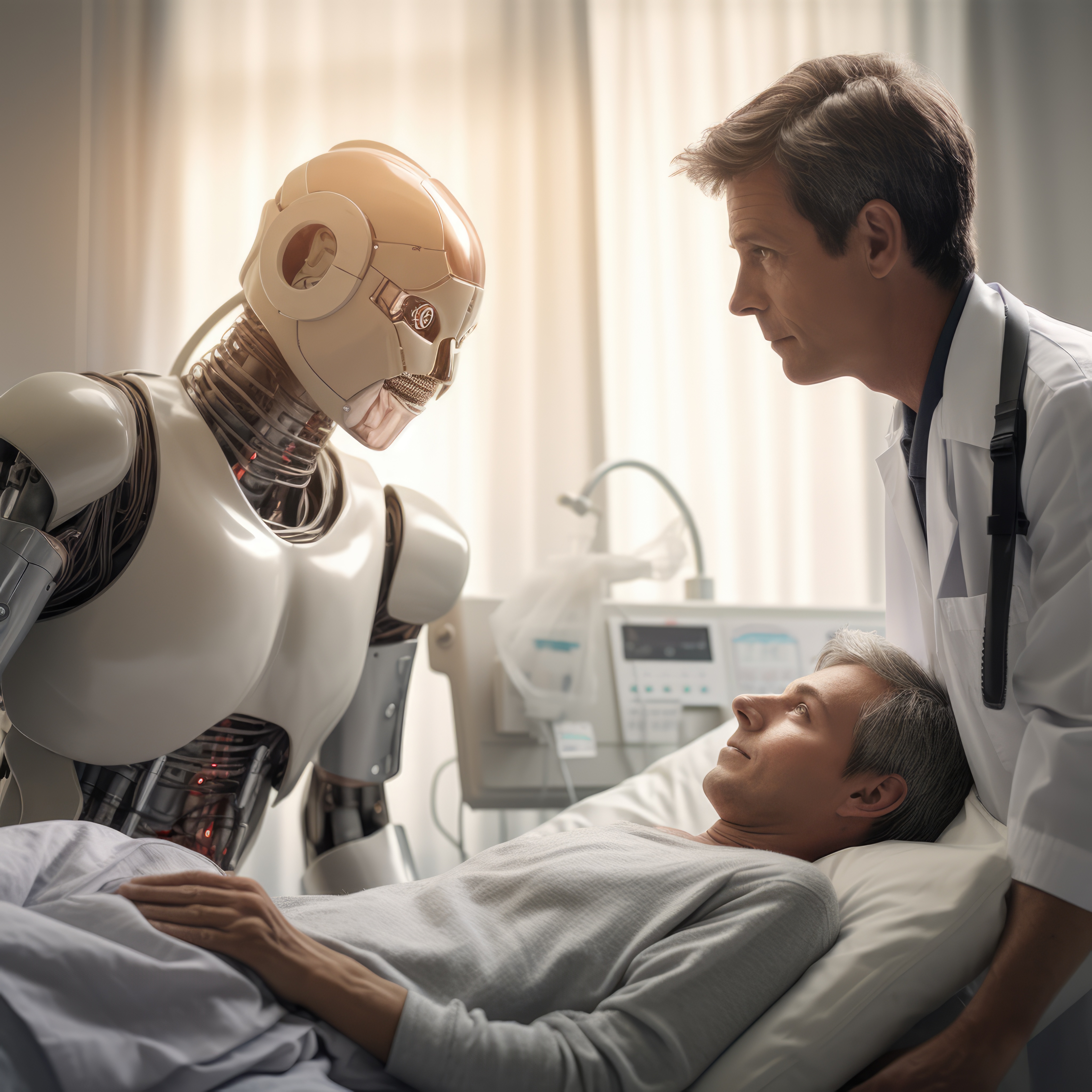
Freepik
AI will, through great effort, unhinge traditional careers such as medicine, with no gain to the patient, or public. This essay argues that AI is inferior to a physicians mind for several reasons. This essay explores the reasons as to why AI is inferior, now and forever, to a physician’s relationship, assessment, and performance.
- A.I. is known to be more empathic, compared to human physicians, through a similar medium: computer monitors. AI scores higher than physicians becasue it has the ability to speak faster, and also deliver the best-in-practice responses that appeal to technical language, emotional language, and words that appeal to gaining and maintaining patient rapport.
List of Publicaly Accessible Resources
Doctronic AI – Cody MD – Robo Clinic – Dr. Khan
Rewards, and Risk of AIMDs
How many HCPs care to hear of WebMD diagnosing patients? Personally, I’ve heard plenty of hums and haws over patients actively participating in their care. While this can be most excellent for giving patient populations the verbiage, and precision, needed to assist their physician, it does come with drawbacks. Namely, patients can be sent wayward by common complaints that are maximized, or minimized: nausea, weakness, weight-loss. On one hand, this indicates a plethora of possibilities; of course, death is at the forefront of everyone’s mind. Contrarialy, the diagnosis could be as simple as mononucleosis, or a benign cold.
Rewards, therefore, are extant in the patient actively participating in their care. Though, if AI is used, by the patient or a close person that is consulting with the patient, then there can be people lead astray. We should not restrict patients from learning about their diseases, or if they attempt to produce a summary report of their complaints in a comprehensive manner. Instead, HCPs must be wary of the degree(s) of error that send a patient into a high-stress state. Living in a feeling of perceived danger can certainly heighten symptoms that otherwise would be mild. In a snowball effect, the symptoms can percipitate others, or increase the severity of symptoms.
Rewards for physicians, and other HCPs are likewise reported. The AMA released a report from a survery which shows that from 2023, to 2024, there has been a roughly 80% increase in physicians using AI.3
The archived AMA report by Henry in 2025 can be found here.
What then is so bad about using AI in clinical, or academic practice? If assisted, or automated HCP daily practice is anything like the advanced driver assistance systems (ADAS), then HCPs have cause for worry.
The IIHS tested ADAS systems from 14 separate carmakers and not a single one of them earned its highest “good rating,” while 11 of the systems received a “poor” rating. The striking IIHS results highlight the importance of rigorous testing to ensure highly-marketed ADAS are actually being used the ways they are advertised and not unintentionally causing more harm than good. 4 5
While there may be other variables that contribute to lower quality reports, handing over responsibilities to a machine that are otherwise under cognitive control by us is certainly evident. How much more can be said about the AIMD relationship? Only time will tell if the generation of those HCPs who still perform metaphorical shoulder-checks, and look both ways out performs the possible future of younger students (who use AI, generally) that neglect low effort safety habits in place of an intelligent algorithm assuming responsibility.6 Though, AI doesn’t have a license to lose: driver’s or medical.
Risks are equally extant as was covered. Leading people astray, magnifying symptoms into a hyperbolic story, or in the worst case which has been reported in the news media: AI has reccomended patients kill themselves. Though these technological hallucinations could be corrected with updates, one life lost to a machine giving advice, and direction, is unacceptable.
Approach to Patients Using AIMD
Tell them no. Though in its adolescent years, AIMDs are a growing problem. Now, many HCPs are stretched thin, and their careers are weights that bring them to the bottom of their performance. Too many patients, and too few providers is a recipe for catastrophe. So, while the government, and active peoples, work on increasing the number of HCPs for their under-served areas, other people seek advice and guidance from AIMDs.
Desires satisfied don’t discriminate. If one has a lacking sense of belonging in person, then some of these people will seek belonging in different places: the Internet, for instance. How much more can be said about people who need a physician to assess, diagnose, and treat their medical complaints? Therefore, we should expect them to supplement their independent care with AIMD dependent care.
How HCPs Should Approach AIMDs
Resist, resist, resist.
Fear is often at the forefront of change. However, when turning the pages of history, we do see some indications of a dark period approaching society. The Industrial Revolution was such an example. People, paupers, who were incentivized to move into the city lost their normal job, or career, and were then asked, through necessity, to do other work. While the Revoltion did bring about necessary industry to propell humanity towards the age we are in now: the age of comfort; it still does have its drawbacks. Instead of making comparisons of by-gone eras with our current day, I’ll merely mention some of what we already see happening with AI in different sectors.
Another practical example that doesn’t need weblinks is this: at one point, we hired security guards to monitor cameras for the safety of whatever property at which they. Though, there are plenty of SaaS (Software as a Service) alernatives, and even self-hosted job-replacing technology. Much like what HCPs face, the security sector will, and has been, reduced to fewer numbers than what once was. Those who weren’t out-right replaced have had their jobs modified which leaves some people asking questions: why are we paying these people as interventionists, or security, when we can simply have AI contact the police? One may answer that police reporting systems aren’t compatible with AI; however, we are not far off. Now, we can text 9-1-1 for help. If 9-1-1 had a receptive AI to take information from a sending AI that an end-user deploys, what is preventing people in the call-taking centers of police, fire, and EMS? Nothing prevents this from happening but time.
Marketers are Changing our Minds
They are good, and can make people think of only the positives becuase once someone reads even one comprehensive news post with positive things in great magnitude, and a few negatives in low magnitude, they build a great amount of trust in whatever product is set before their eyes.
-
Freeman, J. (2025, February 26). Student Generative AI Survey 2025. HEPI. https://www.hepi.ac.uk/2025/02/26/student-generative-ai-survey-2025/ ↩︎
-
Korbmacher, J. (2024, September 24). Logicalmethods.ai – Boolean satisfiability. Logical Methods. https://logicalmethods.ai/textbook/sat/ ↩︎
-
Henry, T. (2025, February 26). 2 in 3 physicians are using health AI—up 78% from 2023. American Medical Association. https://www.ama-assn.org/practice-management/digital-health/2-3-physicians-are-using-health-ai-78-2023 ↩︎
-
DeGeurin, M. (2024, March 13). “Safe” driver assist tools could be doing more harm than good. Popular Science. https://www.popsci.com/technology/driver-assist-features-safety-concerns/ ↩︎
-
IIHS. (2024, March). First partial driving automation safeguard ratings show industry has work to do. IIHS-HLDI Crash Testing and Highway Safety. https://www.iihs.org/news/detail/first-partial-driving-automation-safeguard-ratings-show-industry-has-work-to-do ↩︎
-
Odgers, C. L., & Jensen, M. R. (2020). Annual Research Review: Adolescent mental health in the digital age: facts, fears, and future directions. Journal of Child Psychology and Psychiatry, 61(3), 336–348. https://doi.org/10.1111/jcpp.13190 ↩︎